
If you already know when to go and which area to visit (we covered that in our guide «When to Go, What to Skip, and Whether It’s Worth It»), here’s the practical part: the actual step-by-step itinerary to make the most of the entire park without wandering around unnecessarily or missing the viewpoints that almost no one visits.
Before we begin: two posts, not one
Park Güell has several entrances, but it's best to enter through the main entrance (Carrer d’Olot), which is where the Historic District begins and where the information center is located. If you enter through another entrance (there are several in the upper part of the park, all free of charge), you’ll skip the logical order of the route and it’s easy to get lost among the trails.
Stop 1 — Las Casas de la Entrada
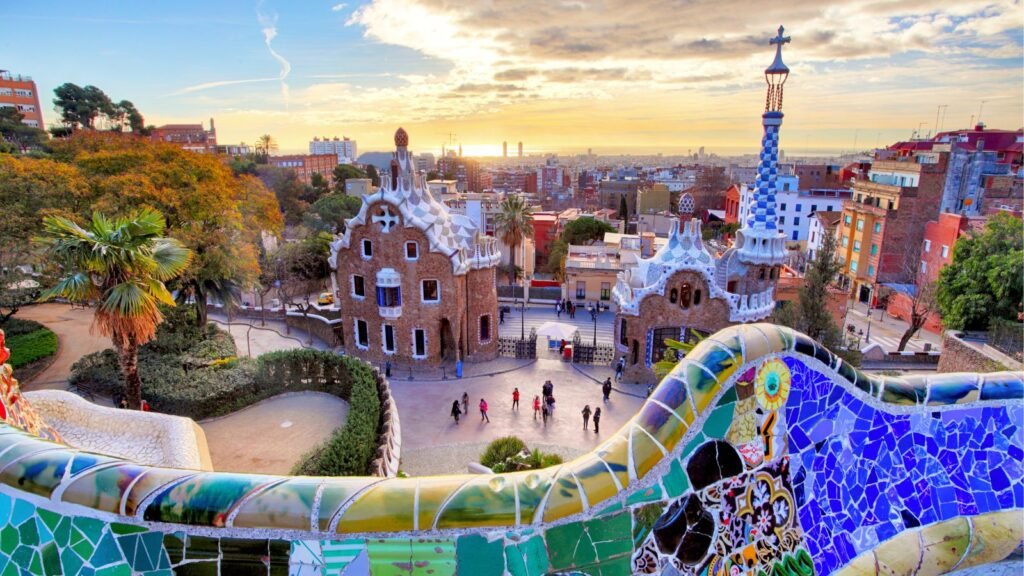
Just past the main gate, two pavilions with undulating roofs covered in trencadís (a mosaic made of broken ceramic tiles) flank the entrance. One served as a gatehouse, the other as the caretaker’s residence. It’s worth stopping here before heading up: they’re among the most photographed buildings in the park, and early in the morning they’re almost empty.
Stop 2 — The Staircase and the Salamander
Heading up from the entrance buildings, you'll reach the main staircase, where the famous mosaic salamander («el drac») is located. As we mentioned in the previous guide, during the first few hours after opening, the line to take a photo is minimal or nonexistent.
Stop 3 — The Hypostyle Hall
At the bottom of the staircase, a forest of 86 Doric columns supports what was to be the market of the original development. It’s worth looking up: the ceiling is decorated with circular trencadís mosaics, each section featuring a different design.
Stop 4 — Nature Plaza (the wavy bench)
Climbing the side staircase from the Hypostyle Hall, you’ll reach the large upper terrace, with its winding mosaic-covered bench that circles the entire plaza. It’s also the best viewpoint in the Monumental Zone overlooking Barcelona and the sea—take a few minutes to sit here, not just for the photo.
Stop 5 — The Lavandera Archway and the Viaducts
Leaving the Monumental Zone and heading into the park (the free section), a covered walkway with slanted columns—designed to resemble tree trunks—connects to the stone viaducts that Gaudí built to bridge the difference in elevation. This section is almost never crowded, and it’s one of the most architecturally interesting parts because you can see the structural work without the decorative mosaic on top.
Stop 6 — El Turó (the park's highest lookout point)
Following the trails up the hill, you’ll come to a small mound with a three-armed cross (the «Turó de les Tres Creus»). It’s the highest point in Park Güell and offers the best views of the entire park—many visitors don’t even know it exists because it’s outside the Monumental Zone and isn’t marked on standard tourist maps.
Stop 7 (optional) — Gaudí House Museum
If you have time and a separate ticket, the house where Gaudí lived for nearly 20 years is located inside the park, near the main entrance. You don't need to combine it with the Monumental Zone—it has a separate admission fee.
Total trip time
Taking your time and stopping at all 7 spots: between 2 and 2.5 hours. If you go straight through, without stopping at the Turó lookout points or the viaducts, you can do it in 60–75 minutes—but you’ll miss the part of the park that almost no one visits.
Alternative order if you're tired
If you'd prefer a short tour (to combine with another visit on the same day), just do Stops 1 through 4—these are the highlights of the Historic District, take about 45–60 minutes, and cover all the «postcard-worthy» sights.
At VenturPass, we're working on a direct ticket booking service for Park Güell and other landmarks in Barcelona—check back soon, or follow us for updates.