

When traveling with children, Valencia is best explored around three main attractions: the Oceanogràfic, Europe’s largest aquarium; the Bioparc, a zoo with no visible cages; and the Turia Gardens, the free park that runs through the city from one end to the other. The key to not wearing yourself out is not to try to visit all three in a single day: each of the first two alone takes up an entire morning or afternoon, and the third is the best way to fill in your free time since it doesn’t depend on schedules or admission fees.
- The Oceanogràfic with Kids
- Bioparc: A Zoo Without Cages
- The Turia Gardens: A Free Activity
- How to Balance Them Without Wearing Yourself Out
- Which One Is Right for You Based on Your Age
The Oceanogràfic with Kids
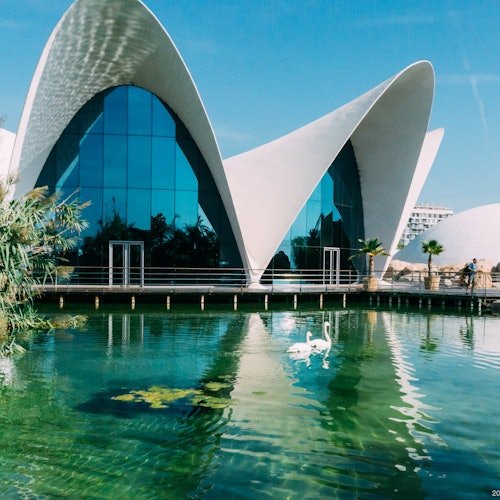
The Oceanogràfic in Valencia is the largest aquarium in Europe, so it’s best to plan for a full day there rather than just a quick stop. Admission also includes the Ágora del Mar, located within the same complex. With young children, the tour usually takes longer than expected: there are areas designed for you to stop and explore, not just pass through.
Keep in mind that tickets cannot be rescheduled or refunded, so it's a good idea to be sure of the date before you buy them, especially if you're traveling with babies or very young children whose nap times might affect your plans.
Bioparc: A Zoo Without Cages
Valencia's Bioparc replaces cages with enclosures and vegetation, so the animals can be seen in an environment that mimics their natural habitat rather than behind bars. The fast-track entrance lets you skip the line at the ticket office, which—with impatient kids—can make all the difference between starting the day off right or wrong.
It's a shorter visit than the Oceanogràfic and works well as a half-day activity, leaving the other half of the day free for sightseeing or relaxing.

The Turia Gardens: A Free Activity
The Turia Gardens occupy the river’s former bed, which was diverted after the 1957 flood, and today form a continuous park that runs through Valencia from one end to the other. There’s no ticket to buy or time slot to reserve: it’s an outing that adapts to your family’s pace, not the other way around.
Inside the park is Gulliver, the giant slide shaped like a reclining character, which is, for many children, the highlight of the entire trip. Since it’s an open-air, free attraction, it works just as well as the main activity for a leisurely afternoon as it does as a way to fill an hour between two other visits.
The park is nearly ten kilometers long, and there’s no need to walk the entire length: the Bioparc is at its western end, within Cabecera Park, while the City of Arts and Sciences, along with the Oceanogràfic, is at the opposite end, near the sea. In other words, each of the two paid attractions has the Turia Gardens practically right at its doorstep, so spending some time in the free park fits in nicely before or after either one without taking you off course.
How to Balance Them Without Wearing Yourself Out
The best combination is to visit a paid attraction in the morning and the Turia Gardens in the afternoon, rather than squeezing in two paid attractions on the same day. The Oceanogràfic and the Bioparc are each enough on their own to fill a long half-day; doing both in a single day leaves little room for breaks, leisurely meals, or unexpected delays with young children.
If your trip lasts several days, the most convenient approach is to spread it out: one day for the Oceanogràfic, another for the Bioparc, and use the Turia Gardens as a fallback option on any free afternoon or as your first stop if you arrive early and the other attractions aren't open yet.
Which One Is Right for You Based on Your Age
Infants and very young children: The Turia Gardens are the most stress-free option, because there are no schedules to coordinate with nap times and no lines to wait in. If you add a paid attraction, the Oceanogràfic allows for a leisurely pace with frequent stops, which is better suited to this age group than a long tour designed for nonstop walking.
Children ages 4 to 10 who are fascinated by animals: Bioparc usually wins because of its close proximity to the animals and because the open-pit design allows visitors to see them without glass barriers in many areas.
Children who are already asking why things happen: The Oceanogràfic is a good fit for this age group because explanations about marine ecosystems are starting to make sense to them—not just as a visual spectacle.
Families staying for several days: Spreading out visits to the Oceanogràfic, Bioparc, and Turia Gardens over different days—in that order of priority if time is tight—is the best way to maintain a steady pace without wearing anyone out.
Groups with children of very different ages: Since Bioparc and the Oceanogràfic are each located next to a different section of the Turia Gardens, there’s always the option for the part of the group that gets tired first to stay at the park while the rest finishes the paid tour, without having to arrange two separate trips.
Keep watching
All the family-friendly activities in Valencia are listed at Activities for the Whole Family in Valencia.
- Oceanogràfic in Valencia: Admission
- Bioparc Valencia: Fast-Track Admission
- Oceanogràfic and Science Museum: Admission
If the plan also includes the Museu de les Ciències or the Hemisfèric, the guide City of Arts and Sciences: How to Plan Your Visit It goes into detail about when it's worth combining them.